
Grundy County Court Records After Arrest
After an arrest in Grundy County, the first public trail may sit with the sheriff as a jail public-information record. That jail record can show the arrest date, arresting agency, charges, and disposition when requested in writing from the Grundy County Sheriff's Office. The court side begins when charges are filed in the Iowa trial-court system. For Grundy County criminal cases, the filed case is searched through Iowa court record search or directly through Iowa Courts Online.
The distinction matters. Jail data describes custody and booking. Court records after a jail arrest show the filed charges, court events, hearing dates, bond entries when public, and final case outcomes. For custody and booking details, use Grundy County jail inmate records. For booking-photo questions, use Grundy County jail mugshots. The court record is the place to verify what the prosecutor filed, whether a charge was amended, and whether a case ended in dismissal, plea, trial, or another disposition.
The Grundy County Clerk of Court is the local court office for follow-up after an arrest case appears. The clerk is at 706 G Avenue in Grundy Center, can be reached at 319-824-5229, and lists public hours Monday through Friday from 8 am to 4:30 pm except judicial holidays. Public case information is free online, but public case documents may require use of a courthouse public terminal in the county where the case was filed.
Find Grundy County Court Records After Arrest
Iowa Courts Online is the main portal for Grundy County court records after a jail arrest. The Iowa Judicial Branch describes the system as the electronic docket for state court cases. A docket is an index of filings and proceedings, not a full substitute for every courthouse file. Public case information can be searched without a subscription. Some links and documents remain limited to a courthouse public terminal or paid subscriber access, so a search result may show that a case exists while the underlying document must be viewed through the clerk's public access terminal.
- Open Iowa Courts Online from the Iowa Judicial Branch court-record search entry page.
- Search by defendant name, citation number, or Case ID when that identifier is known.
- Open the Case ID link in the results to review the criminal docket and filed charge entries.
- Check each charge, event, bond entry, warrant entry, and disposition rather than relying on the first arrest charge.
Timing can explain a missing result. Official Iowa Courts Online help says a new case added to the case-management system takes one business day to appear. Once the case appears, case data updates in real time. That means a person may be booked into the Grundy County Jail before the court case is visible online. If the search has no result on the day of arrest, try again after the court filing window or call the clerk for local case-index questions.
The screenshot below comes from the Iowa Courts Online docket search, the state portal used for Grundy County criminal case lookup after filing.
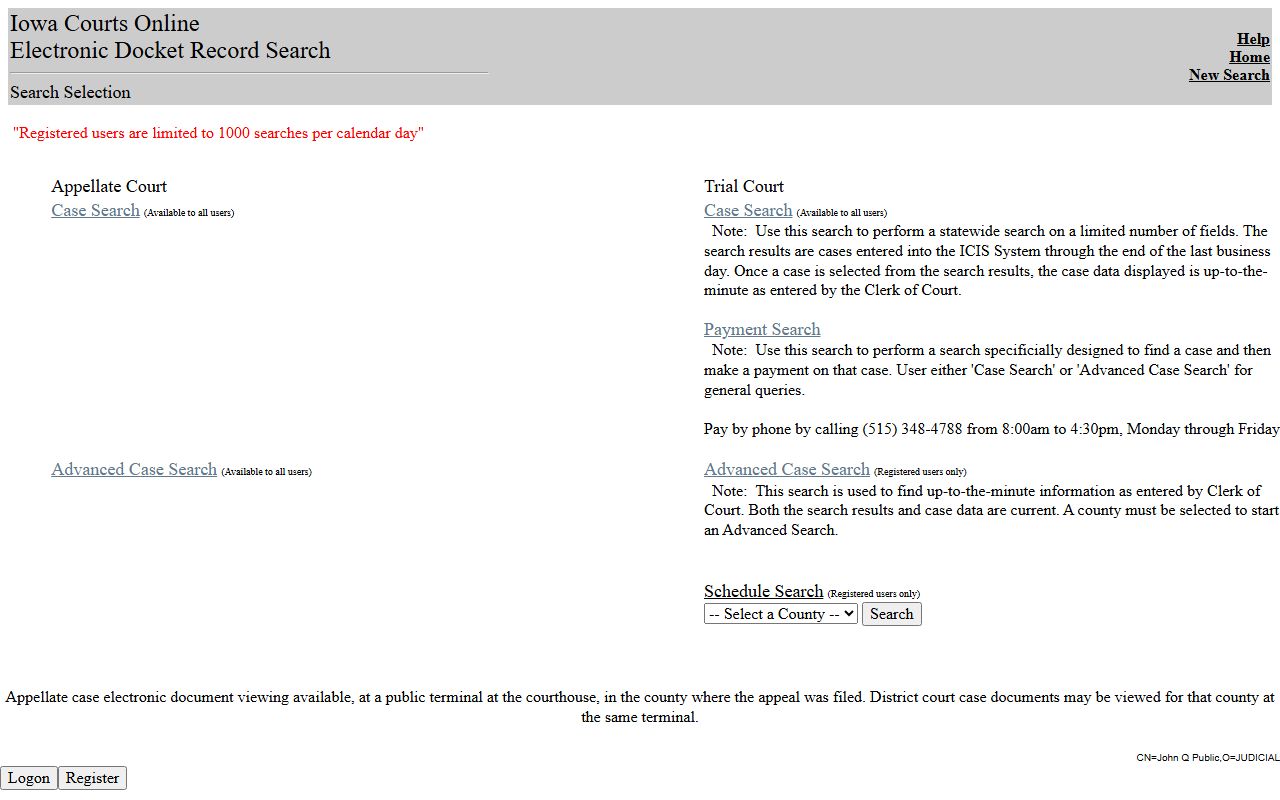
Use the court portal for filed charges and case status, then use the sheriff records process only for jail public-information records tied to the arrest and booking.
Iowa Courts Online Search Fields
Name searches in Iowa Courts Online require careful spelling. Official help states that trial-court name search requires at least two letters of the Last or Firm name, and the First Name field is optional. Case ID search is more precise, but the Case ID has a fixed format. Citation search can help for cases that began with a citation. Advanced fields may be limited by subscription or courthouse terminal access.
| Field Label | Type | Required | Notes |
|---|---|---|---|
| Last/Firm name | Text | Yes for name search | At least two letters are required for trial-court name search. |
| First Name | Text | No | Help notes not to use a period after a first-name initial. |
| Case ID | Text | No | Case ID has 17 characters and letters must be uppercase. |
| Citation Number | Text | No | Use when the arrest or charge was tied to a citation number. |
| Advanced Case Search | Subscriber or terminal fields | Limited | May include case type, status, event, and filed-between filters. |
The clerk's page is useful when the online index does not answer a document-access question. The image below is from the official Grundy County Clerk of Court page, which publishes the local court contact block and public hours.

The clerk is the local contact for courthouse terminal access, file viewing, and case scheduling details that are not fully visible through a public web search.
Grundy County Charging Documents
Formal court records after an arrest are built from charging documents. Grundy County jail records may list arrest charges, but the prosecutor decides what charge language to file in court. The Grundy County Attorney's Office prosecutes state criminal law and county ordinance violations. County Attorney Erika L. Allen's office is at 514 Main Street, PO Box 193, Reinbeck, and the phone number is 319-788-2545. The office does not provide private legal advice, but its public role explains why a court charge may differ from the booking entry.
| Document | Who Uses It | What It Does |
|---|---|---|
| Complaint | Law enforcement or prosecutor | Starts a criminal allegation and may appear early in the case record. |
| Trial Information | Prosecutor | States formal Iowa charges in many criminal cases after review. |
| Indictment | Grand jury process | Charges an offense through grand-jury action when that route is used. |
The screenshot below comes from the official Grundy County Attorney page, which names the local prosecutor and describes the office's criminal and civil duties.

When a Grundy County court record changes from the arrest charge to a filed charge, the change usually reflects prosecutorial review, amendment, reduction, dismissal, or later case disposition.
Grundy County Charge Status Records
Charge status is the running answer to what is happening with a filed accusation. A charge may be pending at first appearance, amended after review, reduced through plea negotiation, dismissed by court order, or resolved by plea or trial. Do not treat the first booking charge as the final court outcome. The court docket and clerk record are stronger sources for filed charge status than a jail arrest entry.
| Status | What It Means |
|---|---|
| Pending | The charge remains open and has not reached final disposition. |
| Amended | The filed charge language, level, or count has changed in the case. |
| Reduced | The charge has been lowered to a lesser charge or lower offense level. |
| Dismissed | The court record shows that the charge was dropped or ended without conviction. |
| Convicted | The charge ended in a guilty plea, verdict, or other conviction entry. |
Note: A jail record can help identify the arrest, but the filed court record is the better source for current charge status.
Bond Records After Grundy County Arrest
Bond is a court-set release condition, not proof that the case ended. Grundy County did not publish jail-specific bond-posting hours, accepted payment methods, or a bond vendor in the inspected official materials. Iowa Courts Online can show public payment and case information, and the county FAQ discusses ticket payments, but those sources do not establish a jail bond window. For release conditions after a jail arrest, verify the court entry, the clerk, and the sheriff before relying on a secondhand bond amount.
| Bond Type | How It Works |
|---|---|
| Cash bond | Money is posted as directed by the court or jail when that option is allowed. |
| Surety bond | A bonding company may post bond if permitted by the court and local rules. |
| Personal recognizance | The person is released on a promise to appear, often with conditions. |
| No-bond hold | Payment alone will not release the person while the hold remains active. |
A hold or detainer can keep someone in custody even when a local bond is posted. A hold means another case, agency, probation or parole matter, warrant, federal issue, or immigration matter prevents release. That is why the sheriff, clerk, and docket should all be checked before assuming a person will leave custody.
Warrants and Arrest Court Records
No official Grundy County Sheriff active warrant search page was located in the inspected county sources. The sheriff page links to Iowa Courts Online, IowaVINE, the Iowa Sex Offender Registry, and other state or federal resources, but it does not publish a county warrant list. A warrant-related arrest may still create or connect to a court case, especially when the warrant is tied to failure to appear, unpaid obligations, or a pending criminal case.
For a warrant question after a Grundy County arrest, use the court docket and the local clerk for case-related events. The sheriff's office at 705 8th Street can be contacted at (319) 824-6933 for sheriff records and custody questions. Someone who believes a warrant exists should contact an attorney, the clerk, or the issuing agency to understand appearance and bond requirements before taking action.
Charges vs Convictions
An arrest charge is an accusation. A conviction is an outcome. Grundy County court records after a jail arrest may show both, but they do not mean the same thing. The filed charge can be amended or dismissed, and a person remains legally presumed not guilty unless the case ends in a conviction. Read each count and its disposition before using the record for any serious decision.
| Question | Charge | Conviction |
|---|---|---|
| Stage | Filed accusation after arrest or citation | Final finding, plea, or verdict |
| Proof level | Lower threshold for filing and court process | Requires guilty plea or proof beyond a reasonable doubt at trial |
| Can change? | Yes, it can be amended, reduced, or dismissed | May be appealed or later affected by lawful post-case relief |
Sealed vs Expunged Records
Iowa public-access law starts with broad access to public records, but criminal records can be limited by confidentiality rules, court orders, juvenile protections, and specific expungement or sealing procedures. Iowa Code chapter 22 governs open records. Iowa Code chapter 692 governs criminal history and arrest data. Iowa Code section 692.2 limits dissemination of some older arrest data when no disposition is available. Court-specific restrictions may also apply to juvenile matters, sealed filings, and documents that are not public online.
| Record Treatment | Public View | Practical Effect |
|---|---|---|
| Sealed | Hidden or restricted by court rule or order | The record may still exist, but public access is limited. |
| Expunged | Removed from ordinary public access if Iowa law allows | The public record may be treated as cleared for specific purposes. |
| Confidential | Not open under a public-record exception | Access depends on the statute, record type, and requester authority. |
Note: Iowa access rules are specific to the record type, so dismissal alone does not prove that every arrest or court entry has disappeared.
Public Access to Arrest Court Records
Iowa Code chapter 22 gives the public the right to examine, copy, and disseminate public records unless a confidentiality exception applies. Iowa Code chapter 692 defines arrest data and correctional data, while Iowa Code section 692.2 addresses criminal history data dissemination. Those laws help explain why basic arrest and charge information can be public while investigative files, confidential identification files, juvenile records, or restricted case documents may not be open in the same way.
The statewide criminal history route is separate from Iowa Courts Online. The official Iowa criminal history background check process runs through Iowa DCI and requires identifying information such as first name, last name, and date of birth. The research file documents a $15 per-check fee for that official channel. It is a statewide criminal-history request, not a substitute for reading a Grundy County court docket after an arrest.
Important: Public court lookup is not a consumer report and should not be used for credit, housing, employment, insurance, or tenant screening.